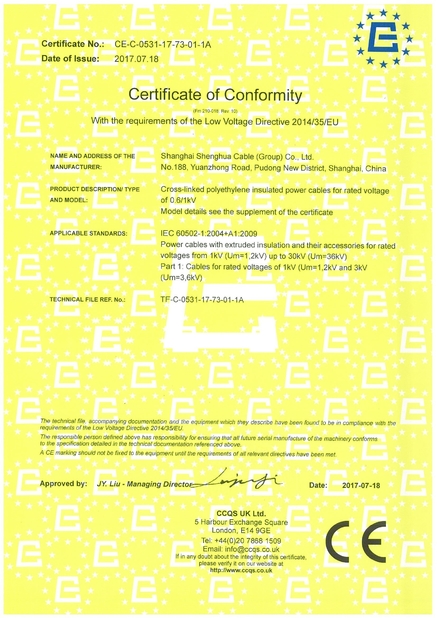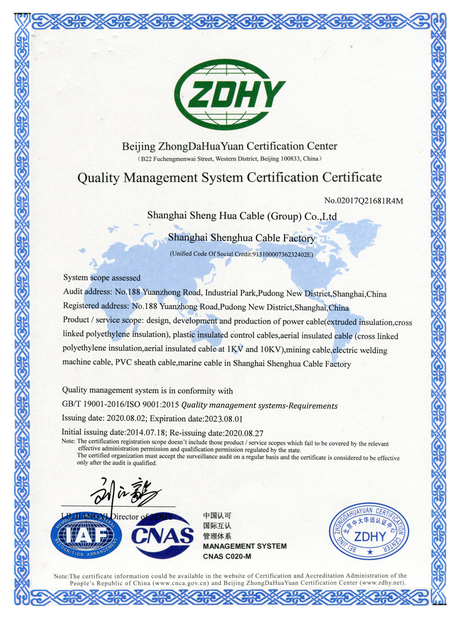
Thượng Hải Shenghua cáp (Group) Co, Ltd
Water blocking cable is the specification that decides whether a buried feeder survives fifteen years or fails in five. Moisture enters an underground cable through a damaged sheath, an imperfect joint or a cut end left open overnight, and once inside a stranded conductor it travels along the strands by capillary action until it reaches a termination or a joint. This guide explains the difference between longitudinal and radial water blocking, how swelling tapes and powders work, why water trees destroy XLPE insulation, and how IEC 60502-1 treats flooded installations. It then sets out a practical specification and installation sequence for direct burial, plus six straight answers on immersion testing, jointing and HDPE sheaths for wet ground.

Water ingress is usually described in two directions. Longitudinal ingress travels along the length of the cable inside the stranded conductor, inside the gaps between cores or along the interface between insulation and sheath. Radial ingress moves from the outside of the cable towards the conductor through the sheath, the bedding and the insulation. A water blocking cable design must address both, because stopping one without the other simply relocates the failure.
Longitudinal blocking is achieved by filling the interstices of the stranded conductor with a water swellable powder or a water swellable tape, and by wrapping the cable core with swellable tape before the sheath is applied. When water reaches the powder, it absorbs many times its own mass and forms a gel plug that arrests further travel within a short length. In three-core cables, fillers between the cores and a binder tape perform the same function. Radial blocking is achieved by a continuous extruded sheath, usually PVC, PE or HDPE, sometimes combined with a longitudinally applied aluminium or copper tape in a bonded construction that is impermeable by definition.
| Blocking element | Direction addressed | Typical material |
|---|---|---|
| Conductor fill | Longitudinal, inside strands | Water swellable powder or yarn |
| Core wrap tape | Longitudinal, between cores | Water swellable tape |
| Bedding / filler | Longitudinal, three-core gaps | Swelling compound or filled bedding |
| Oversheath | Radial | PVC, PE or HDPE |
| Metallic laminate | Radial, hermetic option | Bonded aluminium tape |
| End seal | Both, during transport | Heat-shrink cap or mastic |
The terms water resistant, waterproof and watertight are not interchangeable. A water resistant cable resists occasional wetting; a waterproof cable is designed for continuous exposure to water at moderate pressure; a watertight or water blocking cable is designed to limit the volume of water that can travel inside the assembly even after a sheath breach. Submersible applications, wells, fountains and flood prone pits need the third category, and the specification should say so in words rather than relying on a picture in a brochure.
Buried cable fails slowly and then all at once. Water does not usually cause an immediate breakdown; it starts a chain of degradation that ends in a through-fault months or years later, often during a peak load period, and always at the least convenient location.
1. Water treeing in XLPE. Under the combined influence of moisture and electrical stress, microscopic voids and contaminants in XLPE insulation develop tree shaped structures known as water trees. They grow from the outer or inner surface of the insulation inwards, and when one bridges the insulation the cable fails. Water trees need both water and field, so a dry insulation system is a long lived one. Water blocking compounds and a reliable oversheath are the primary defence.
2. Corrosion of armour and metallic screens. Steel wire armour, steel tape armour and copper screens corrode in the presence of water and oxygen. In galvanised steel armour the zinc coating is consumed first, then the steel, and the armour loses its mechanical function exactly when it is needed to resist ground movement. The result is a cable that is still electrically sound but no longer protected, and a replacement that cannot be postponed.
3. Joint and termination damage. Water arriving at a joint from inside the conductor is far more damaging than water arriving from outside, because the joint body is usually sealed against external moisture but not designed for internal pressure. Once water reaches a crimp, electrochemical corrosion begins and the contact resistance rises, producing a hot spot that eventually burns through. This is why every specification for wet locations should combine water blocking cable with sealed joints and a strict rule that cut ends are capped immediately.
4. Cost of excavation. The direct cost of the cable is rarely the dominant cost of an underground failure. Excavation, reinstatement, traffic management, permit fees and outage compensation usually exceed the cable price by a large multiple. In urban distribution, a single unplanned joint excavation can cost more than the entire water blocking upgrade on the same route, which makes the upgrade easy to justify on any life cycle basis.
Specify the exposure first. A cable in a dry indoor duct needs no water blocking. A cable in an outdoor duct that may flood, a direct buried feeder in wet ground, a river crossing, a cable in a pump pit, or a submersible pump riser all need a defined level of protection, and the level should be written into the purchase specification as a test rather than an adjective. Common formulations include: longitudinal water blocking verified by a water penetration test on a finished cable sample, radial protection verified by an immersion test at stated depth and duration, and for submersible duty an IP68 statement supported by a pressure and immersion test report.
Then choose the construction. For direct burial in normal soil, an armoured XLPE cable with a PE or HDPE oversheath and swellable tape is the standard solution: the armour resists mechanical damage and the sheath resists soil moisture and chemicals. For wet or waterlogged ground and for river crossings, an HDPE sheath with a bonded aluminium laminate gives a hermetic barrier and is the construction used where long term water pressure is expected. For submersible pumps and fountains, a flexible rubber or elastomer sheathed cable rated IP68 is appropriate because it must also tolerate continuous flexing and frequent handling.
Installation practice matters as much as the construction. Lay the cable on a bed of sand or selected fill free of sharp stones, at the specified depth, with a warning tape above it. Where the route crosses a road or a structure, use a duct with sealed ends and a draw pit that drains. Never leave a drum end uncapped overnight; a single night of rain is enough to fill the conductor strands, and no amount of external sealing afterwards will remove that water. Where a joint is unavoidable, use a joint designed for the same water blocking class as the cable, and record the location precisely so that future excavation does not damage it.
Testing and documentation close the loop. Commissioning should include insulation resistance at 1000 V or 2500 V depending on voltage class, a sheath test where an outer sheath test is specified, and a continuity check of the armour and screen. For long routes it is worth recording the insulation resistance trend at each joint rather than a single pass value, because a slowly falling value is the earliest warning of moisture ingress. Records of joint positions, drum lengths and test values turn a future fault from an excavation lottery into a targeted repair.
| Situation | Recommended construction | Verification |
|---|---|---|
| Normal dry soil | Armoured XLPE, PE sheath, swellable tape | Water penetration test |
| Wet or waterlogged ground | HDPE sheath, water blocking fill | Immersion test at depth |
| River or lake crossing | Hermetic laminate, heavy armour | Immersion plus sheath test |
| Submersible pump | Flexible IP68 rubber sheathed | IP68 immersion report |
| Flood prone pit | Water blocking plus sealed glands | Insulation resistance trend |
Typical products include the waterproof PVC and XLPE cable in armoured and unarmoured versions for general buried distribution, and the 1x630mm2 HDPE sheathed water blocking aluminium XLPE cable for heavy feeders where a hermetic barrier is required. For direct burial the IP68 waterproof PVC insulated cable 4x25mm2 for underground direct burial is widely used, while wet areas and outdoor installations can use the waterproof moisture resistant cable 2x4mm2. Industrial and mining circuits frequently choose the VGV 3x6mm2 IP67 waterproof cable, and pumping applications use the IP68 submersible cable 4x10mm2 for underwater pumps or the H07RN-F 4x6mm2 rubber sheathed deep well pump cable.
A short checklist prevents most buried cable mistakes. Confirm the water table and soil chemistry along the whole route, not only at the two ends, because a single waterlogged section dictates the construction for the entire drum length. Confirm whether the route passes under roads, railways or drainage, and whether the duct will drain or hold water. Confirm the maximum expected water head in metres rather than a verbal description of the site. Confirm the jointing method and who will carry it out, because a water blocking cable joined with a non-blocking kit has no blocking at the weakest point. Confirm the test protocol and the acceptance criteria in writing before the order, so that the factory test and the site test measure the same thing. Finally, confirm the sheath material against the expected chemical exposure: HDPE for saline and aggressive ground, PVC for neutral soil, and a hermetic laminate where long term water pressure is expected. A buyer who answers these seven questions before issuing the purchase order will almost never need to excavate a failed cable within its design life.
Standards give the buyer a common language for these tests. IEC 60502-1 sets out construction and test requirements for 0.6/1 kV extruded insulation power cables, while IEC 60811 covers the mechanical and physical test methods used to verify sheaths and compounds. Where a project specifies a flooded installation, the purchaser should state the test method, the water head, the duration and the pass criterion in the data sheet, and require the factory to record the result on the routine test certificate for each drum. That single paragraph in a specification removes most of the ambiguity that later becomes a claim.
Water blocking limits how far water can travel inside the cable after a breach, usually with swellable tapes and powders. Waterproof describes the ability to resist continuous external water exposure. Many buried cables need both.
No. Armour protects against mechanical damage from stones, digging and ground movement. Water blocking protects against moisture. Direct burial specifications usually require both.
A finished cable sample is conditioned, a controlled water head is applied at a cut end for a defined period, and the length of water travel is measured. The pass criterion is written into the purchase specification.
HDPE has lower moisture vapour transmission and better chemical resistance, so it is preferred in wet, saline or chemically aggressive ground. PVC remains adequate in normal dry soil.
Not reliably. Water trees remain in the insulation even after drying, and corrosion products stay in the strands. The safe action is replacement of the affected section.
Joints should be minimised. Where unavoidable, use a joint of the same water blocking class, seal it fully, and record its position so future work avoids it.
Water is patient, and underground cable has no way to dry out. Specify longitudinal blocking in the conductor and between cores, radial protection from a continuous sheath or a hermetic laminate, and a test that proves both rather than a marketing adjective. Install on clean bedding at the correct depth, cap every cut end before the drum leaves the store, joint only where unavoidable, and record the results. Shanghai Shenghua Cable Group manufactures armoured and unarmoured water blocking XLPE and PVC cables with PE or HDPE oversheaths, submersible IP68 constructions and flexible rubber sheathed pump cable, all supported by water penetration and immersion test reports. Describe your soil condition, water table and burial depth through our contact page and our engineers will specify the construction, the test protocol and the drum lengths for your route.