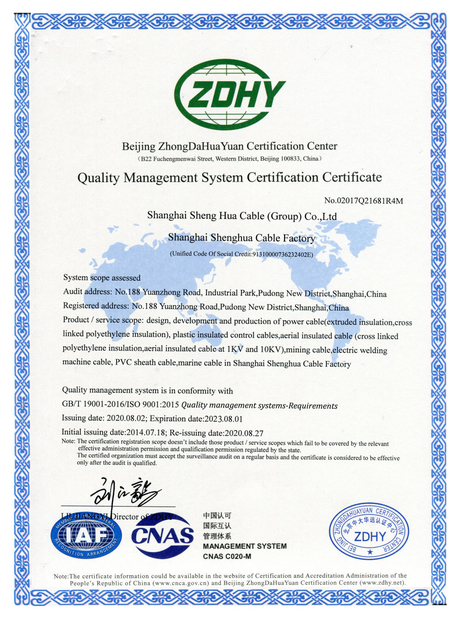
Thượng Hải Shenghua cáp (Group) Co, Ltd

Việc lựa chọn tiết diện cáp phù hợp là nền tảng của hệ thống điện an toàn, hiệu quả và tiết kiệm chi phí. Nhiều kỹ sư dựa vào kinh nghiệm hoặc các quy tắc đơn giản hóa, có thể hoạt động trong ngắn hạn nhưng có thể dẫn đến quá nhiệt, sụt áp quá mức hoặc hỏng cách điện sớm.
Shenghua Cable (Shanghai Shenghua Cable Technology Group Co., Ltd.), với hàng thập kỷ kinh nghiệm trong sản xuất cáp và các dự án quốc tế, chia sẻ bốn phương pháp khoa học để lựa chọn tiết diện cáp cho các ứng dụng đa dạng.
Khám phá các sản phẩm của Shenghua Cable tại đây:https://www.shanpowercable.com/
Cáp được thiết kế để mang một dòng điện nhất định mà không vượt quá nhiệt độ cho phép dài hạn. Vượt quá nhiệt độ này sẽ đẩy nhanh quá trình lão hóa cách điện và có thể làm giảm tuổi thọ.
Cách điện PVC: tối đa 70°C
Cách điện XLPE: tối đa 90°C
Ví dụ:
Máy biến áp: 2500 kVA, nguồn cấp 10 kV
Loại cáp: XLPE, lắp đặt trên cầu cáp
Bước 1: Tính dòng điện định mức
I=250010.5*1.732≈137AI = frac{2500}{10.5 times 1.732} approx 137A
Bước 2: Kiểm tra catalog cáp
YJV-8.7/10KV-3X25 → 120A
YJV-8.7/10KV-3X35 → 140A
Bước 3: Chọn cáp
YJV-8.7/10KV-3X35 đáp ứng 137A một cách an toàn
Mẹo: Luôn xem xét điều kiện môi trường và phương pháp lắp đặt khi sử dụng phương pháp này.
Phương pháp này cân bằng giữa chi phí vật liệu và hiệu quả năng lượng. Chọn cáp quá nhỏ sẽ làm tăng tổn thất, trong khi cáp quá lớn sẽ làm tăng đầu tư không cần thiết.
Quy trình:
Xác định dòng điện định mức của thiết bị
Tính toán số giờ hoạt động hàng năm
Tra cứu mật độ dòng điện kinh tế (A/mm²) cho số giờ đó
Chia dòng điện thiết bị cho mật độ kinh tế để xác định tiết diện
Ví dụ:
Dòng điện thiết bị: 150A
Hoạt động: 8000 giờ/năm
Mật độ kinh tế: 1.75 A/mm²
S=1501.75≈85.7 mm²S = frac{150}{1.75} approx 85.7 text{ mm²}
Bước 2: Chọn kích thước tiêu chuẩn gần nhất → 95 mm²
Điều này đảm bảo kích thước cáp hiệu quả về chi phí với tổn thất điện năng tối thiểu.
Các đoạn cáp dài có thể bị sụt áp đáng kể, ảnh hưởng đến hiệu suất và hiệu quả của thiết bị nhạy cảm. Giới hạn sụt áp thường là ≤7% đối với hệ thống điện áp thấp (400V).
Công thức sụt áp:
S=I⋅ρ⋅LΔUS = frac{Icdot rho cdot L}{Delta U}
III = dòng điện định mức
ρrhoρ = điện trở suất của dây dẫn (Ω·mm²/m)
LLL = chiều dài cáp (m)
ΔUDelta UΔU = sụt áp cho phép
Ví dụ:
Điện áp thiết bị: 380V
Dòng điện định mức: 150A
Chiều dài cáp: 600 m
Điện trở suất đồng: 0.0175 Ω·mm²/m
Sụt áp cho phép: 26.6V
S=150*0.0175*60026.6≈59.2 mm²S = frac{150 times 0.0175 times 600}{26.6} approx 59.2 text{ mm²}
Bước 2: Chọn kích thước tiêu chuẩn gần nhất → 70 mm²
Điều này đảm bảo điện áp ổn định ở đầu thiết bị.
Đối với hệ thống điện áp cao, cáp phải chịu được tác động nhiệt của dòng điện ngắn mạch mà không làm hỏng cách điện.
Công thức:
Smin=IdtiCS_{min} = frac{I_d sqrt{t_i}}{C}
IdI_dId = dòng điện ngắn mạch
tit_iti = thời gian hoạt động của bộ ngắt mạch
CCC = hệ số nhiệt của cáp (80)
Ví dụ:
Dòng điện ngắn mạch: 18 kA
Thời gian bộ ngắt mạch: 0.25 s
Smin=18000*0.2580≈112.5 mm²S_{min} = frac{18000 times sqrt{0.25}}{80} approx 112.5 text{ mm²}
Bước 2: Chọn kích thước tiêu chuẩn gần nhất → 120 mm²
Ngay cả đối với các thiết bị có định mức thấp, cáp cũng phải mang dòng điện ngắn mạch một cách an toàn.
Shenghua Cable cung cấp:
Cách điện được sản xuất chính xác cho độ bền điện môi nhất quán
Vỏ gia cố để bảo vệ cơ học và môi trường
Tuân thủ các chứng nhận quốc tế
Hướng dẫn kỹ thuật để định cỡ cáp cho từng dự án cụ thể
Các tính năng này đảm bảo hệ thống điện của bạn an toàn, hiệu quả và bền bỉ.
Truy cập trang web của chúng tôi để biết thông số kỹ thuật và hỗ trợ dự án:https://www.shanpowercable.com/
Việc lựa chọn tiết diện cáp là một quyết định đa chiều. Bằng cách xem xét:
Khả năng mang dòng dài hạn
Mật độ dòng điện kinh tế
Sụt áp
Độ ổn định nhiệt khi ngắn mạch
Các kỹ sư có thể đạt được sự an toàn, hiệu quả và tiết kiệm chi phí tối ưu.
Shenghua Cable kết hợp các vật liệu chất lượng cao với chuyên môn kỹ thuật để cung cấp các giải pháp cáp đáng tin cậy, lâu dài cho các dự án công nghiệp, năng lượng và cơ sở hạ tầng trên toàn thế giới.